
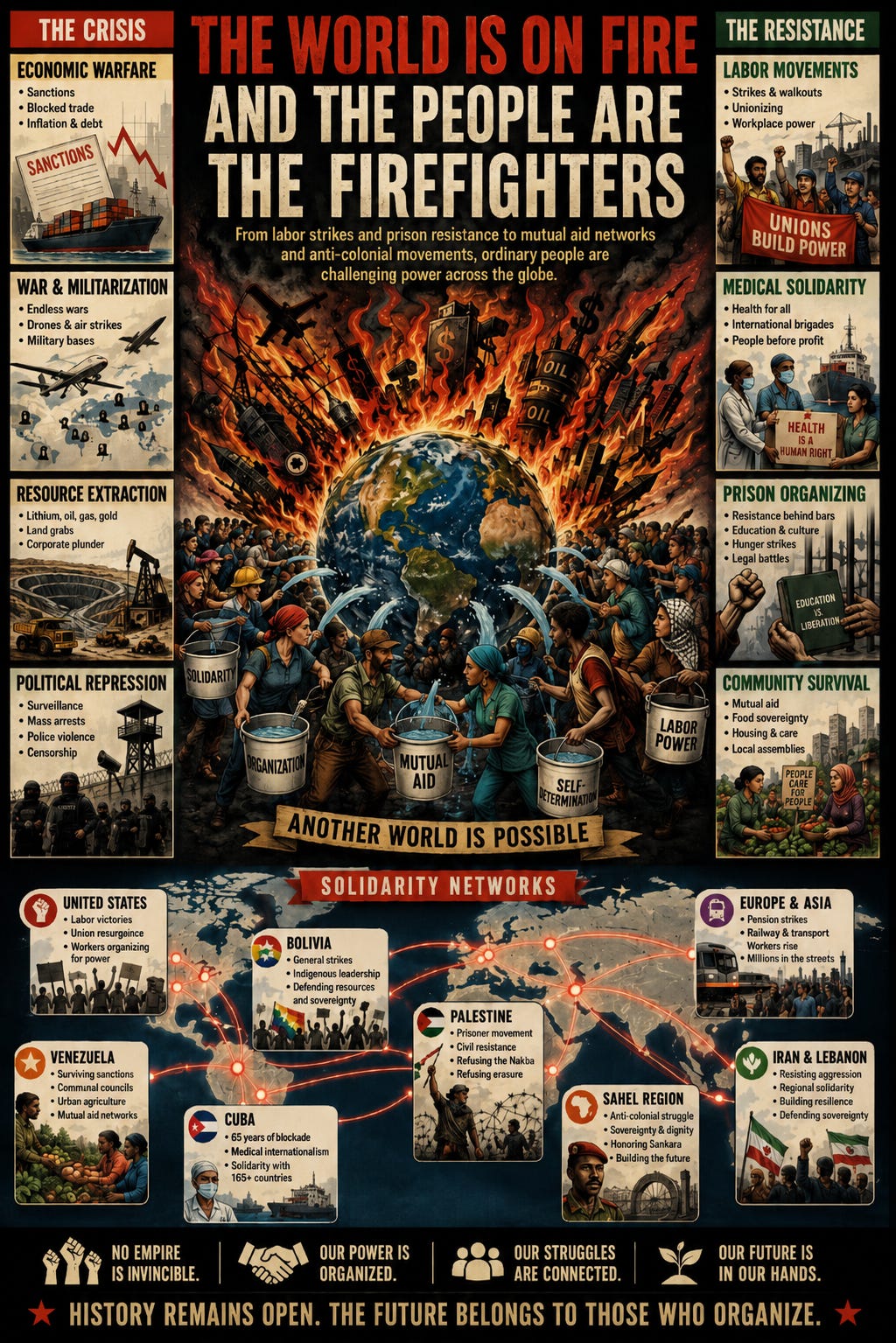
Across every continent, the machinery of the empire is grinding against the bones of the working class. But from the ashes of neoliberal catastrophe, a new internationalism is rising—not from boardrooms or parliaments, but from the streets, the prisons, the picket lines, and the liberated zones. This is not a moment of despair. It is a moment of ferocious, organized, and irreversible resistance.
Bolivia is burning under the boot of a US-backed far-right regime. An indefinite general strike—one of the longest in the country's modern history—has been met with bullets, mass arrests, and the rapid fire sale of public resources to foreign vultures. Water, lithium, and natural gas are being handed to transnational corporations while police beat back Indigenous communities and unionized workers. But the Bolivian working class is not bowing. Blockades have paralyzed export routes, factory councils have taken over shuttered workplaces, and the memory of Evo Morales's anti-neoliberal revolution fuels every barricade. The people are saying clearly: not one more drop of lithium leaves this land without our consent.
In Cuba, a 63-year economic blockade—condemned annually by an overwhelming majority of the United Nations—has failed to break the island's revolutionary spine. Despite being arbitrarily relisted as a state sponsor of terrorism, despite a covert "friendly takeover" campaign disguised as humanitarian aid, despite relentless media warfare painting socialism as starvation, Cuba continues its medical internationalism on a scale the West cannot comprehend. Since 1960, over 500,000 Cuban health workers have served in 165 countries, fighting Ebola in West Africa, COVID-19 in Italy, and treatable diseases in the poorest corners of the planet. The resistance here is not a protest; it is a survival machine. And it works.
Palestine remains the open wound of the modern world. Inside Israeli prisons—where over 1,000 Palestinians are held in administrative detention without charge or trial, where torture is systematic, where children are shackled and interrogated alone—the Palestinian Prisoners' Movement has transformed dungeons into universities. Hunger strikes have forced concessions. Legal battles have exposed the rot. Secret schooling inside cells has produced poets, lawyers, and organizers. The Nakba never ended, but neither has the resistance. Every prisoner released is a living weapon. Every Nakba Day march is a refusal of erasure. The world watches, but Palestine acts.
France, expelled from Mali, Burkina Faso, and Niger after decades of resource theft and military meddling, refuses to accept defeat. In Nairobi, Paris recently attempted to rebrand colonial extraction as "partnership" through a summit of African heads of state. But Pan-Africanist organizers answered with a counter-summit against imperialism, exposing France's new covert offensive: private military contractors, disinformation campaigns, and economic strangulation designed to reassert control over uranium and gold. Burkina Faso, now under revolutionary leadership, is building a memorial to Thomas Sankara at the exact spot where he and twelve comrades were gunned down in 1987—a daily reminder that assassinating a revolutionary does not kill the revolution. The Sahel is rising, and France is running.
Venezuela survives the unthinkable. Over 930 unilateral sanctions—classified by the UN special rapporteur as a crime against humanity—have targeted everything from food imports to cancer medicine. The US has openly discussed military invasion, labeled the democratically elected government a "narco-terrorist" entity, and funded a decade of coup attempts. Yet Venezuelan workers have built communal councils, urban agriculture networks, and a barter economy that sidesteps the blockade. The resistance is not glamorous. It is a grandmother growing vegetables on a balcony and a factory worker repairing broken machinery with salvaged parts. But it is holding.
Iran is being bombed under the Orwellian slogan of "peace through strength." Cyberattacks, assassinations of nuclear scientists, and covert drone strikes have failed to destabilize a nation that has withstood coup, war, and sanctions for over four decades. Lebanese resistance factions, meanwhile, continue to face daily Israeli violations of airspace and ceasefire agreements, yet Hezbollah and allied movements have rebuilt supply chains, trained thousands of fighters, and maintained a deterrent that has prevented full-scale invasion. The axis of resistance is not a conspiracy theory. It is a material fact.
In the United States, a wave of high-profile labor victories—from auto workers to Hollywood writers—has shattered the narrative that organizing is dead. Union approval ratings are at a six-decade high. Starbucks and Amazon workers are winning elections. The Teamsters are threatening a general strike. This is not a revival; it is a reawakening of a class consciousness that neoliberalism tried to euthanize. In France, pension strikes brought millions into the streets, forcing the Macron government into retreat. In South Korea, militant railway and trucker strikes paralyzed supply chains. In Argentina, with inflation soaring past 250%, newly elected far-right austerity hawks face immediate resistance from the very workers they promised to crush.
Across the Global South, the mask of liberal "diplomacy" is slipping. US military bases in Asia—over 800 of them, from the Philippines to Japan—are repackaged as "protection," but Okinawans, South Koreans, and Filipinos know the truth: bases bring rape, pollution, and the constant threat of being dragged into someone else's war. Resistance there is daily, legal, and sometimes deadly.
What unites these struggles is not a flag or a leader. It is the recognition that no empire is invincible. The British Empire fell. Apartheid fell. The Soviet bureaucracy collapsed. And the US-led NATO order, with its collapsing currencies, overstretched supply lines, and moral bankruptcy, is already in its dying phase. The question is not whether the old world will end. The question is what we will build in its ruins.
The peoples are not defeated. The peoples have power—real, organized, material power. Strikes disrupt profits. Blockades stop armies. Prisons produce revolutionaries. Medical brigades outlive blockades. History remains open. And the workers of the world, from La Paz to Gaza to Havana to Ouagadougou, are writing the next chapter with their own hands.
Solidarity is not a slogan. It is the only weapon that works.
Great post, factual and truly uplifting. Love it.
It could be easily extended to Sweden, Denmark and Norway who are pushing very strong social welfare programs, universal healthcare, and extensive public services, all within a democratic socialist framework.
Recent dissent in Italy and blocking Israeli guns supply ships and marching against illegal war on Iran and against the genocide of Palestinians and Lebanese are brightest examples of coordinated strikes and unity between workers and democratic civil society.
Another great addition is uprising and protracted demonstration of Albanians against corruption, spiking the laws and sell of country resources to Jewish billionaires and Trump family.
Peace through War, Strength Through Domination, Wealth Though Poverty, Saiety Through Hunger, Domination Through Capilulation, Voting Though Trump...
My next book should be titled 1984 (through 2036). Huxley's New World...